

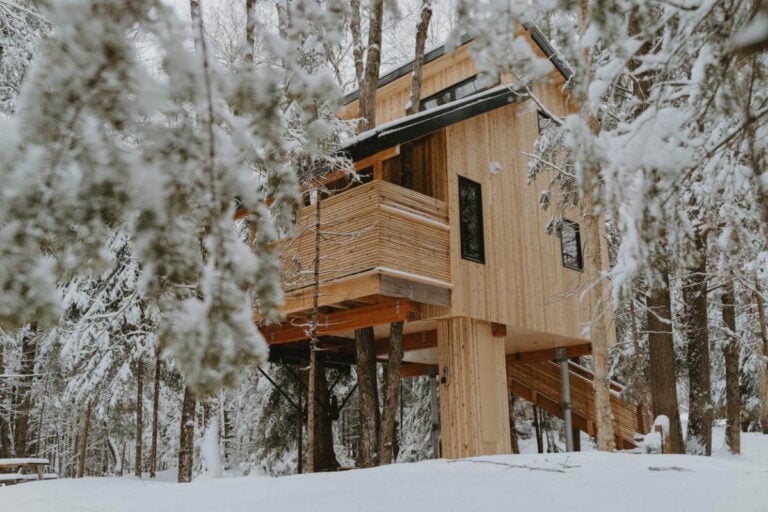
Architect Lukasz Kos didn't string a platform between trees. He drew a circle around four of them, let the trunks dictate the geometry, and suspended the result on high-strength steel cables — one per tree — so each trunk could continue to thicken, flex and live without interference. Arborists joined the project before builders did. That sequence matters. The 4treehouse, on the shores of Lake Muskoka in Ontario, is the rare structure that treats its hosts as collaborators rather than posts.
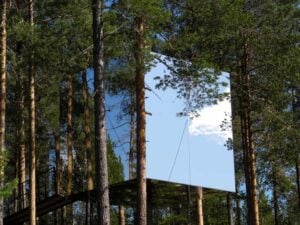
The lattice-frame cylinder that emerged from that process has an almost theatrical relationship with light. By day, narrow cladding slats filter sunlight into pale, shifting bands across the interior — the room feels connected to the canopy rather than sealed from it. After dark, the logic reverses. The skin becomes a lantern: the whole volume glows softly between trunks, a quiet nod to Japanese design philosophy translated into very Canadian materials. It's deliberate without being showy, and it reads differently every hour.
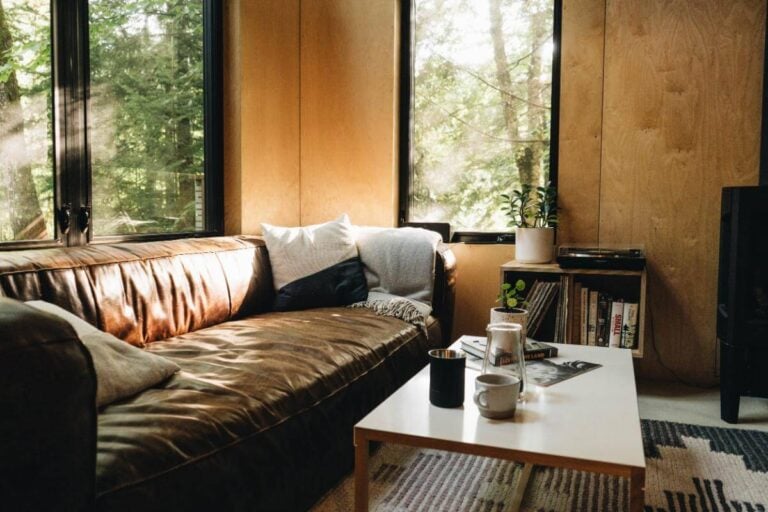
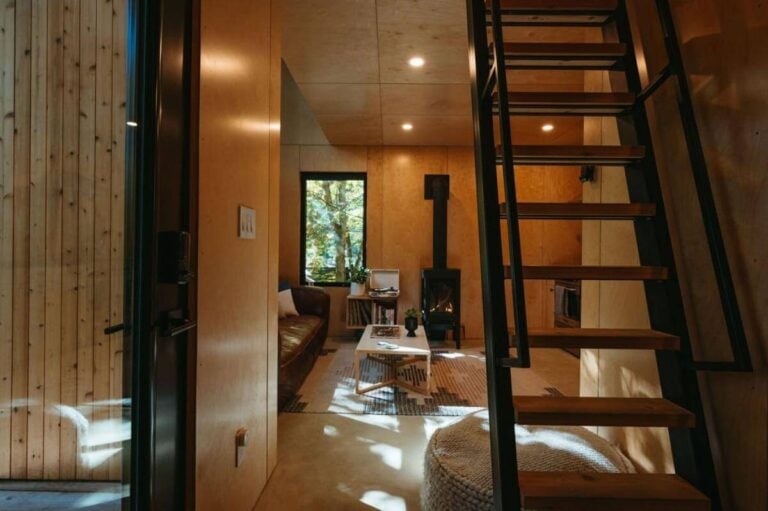
Inside, 410 square feet stack with the efficiency of a small tower — tight stair, framed views, warm boards underfoot, structural elements that don't dress themselves up. Air moves through the slats freely, carrying pine and lake in small, steady drafts. The interior never feels sealed because, structurally, it isn't.
The most underappreciated detail sits at ground level. The access stair rolls on casters across two stone pads, allowing entry to stay level even as the canopy sways or the seasons shift the site. It is the kind of solution you register only by noticing how little it asked of you — an elegant concession to a living, moving structure. This is the patience that reads as simplicity once a project is finished.
Lake Muskoka amplifies everything the building offers. From the deck, water flickers through branches, granite outcrops push up through the boreal floor, and Canada's long northern light arrives at a slant that turns ordinary evenings into something worth staying awake for. Summer, from June into August, brings warm days, swimming-friendly water and the full cottage-country atmosphere the region is known for. Autumn draws photographers: September and October deliver spectacular fall colour around the lake, cooler temperatures and noticeably quieter mornings on the water.
Getting to Lake Muskoka is most practical by car. For those travelling without one, ONTC bus services stop in Bracebridge — the Bracebridge Rest Stop and the central Bracebridge stop both lie approximately six kilometres from the property address on Mcvittie Road. From Bracebridge, onward travel to the lake would require a local taxi or rideshare. Public transport reaches the town; the final stretch to the site is road-dependent.
The 4treehouse suits design-minded travellers who want architecture to do more than provide shelter. It suits anyone drawn to the Shield landscape — the granite, the pines, the loon at unreasonable hours. It suits people who understand that the best version of a treehouse is one where the trees are still clearly winning.
Frequently Asked Questions
Q: How is the treehouse actually supported — does it harm the trees?
A: Architect Lukasz Kos designed the 4treehouse to work with the four host trees rather than against them. The structure is suspended by one high-strength steel cable per tree, minimising contact so each trunk can continue to thicken, flex and grow. Arborists were brought into the project before construction began, and the geometry of the cylindrical frame was drawn around the trees, not imposed upon them.
Q: What is the access like, and do I need a car to get there?
A: The 4treehouse sits on Lake Muskoka near Bracebridge, Ontario, and the location is car-dependent for most of the journey. ONTC bus services do stop in Bracebridge — roughly six kilometres from the property on Mcvittie Road — but the final stretch to the site requires a taxi or rideshare. Driving remains the most straightforward option.
Q: When is the best time to visit?
A: Summer (June to August) is peak season: warm days, swimming-friendly water and long evenings on the deck give the full cottage-country experience Lake Muskoka is known for. Autumn — particularly September and October — is worth serious consideration too, with spectacular fall colour around the lake, cooler but comfortable temperatures and noticeably quieter mornings on the water. Spring is peaceful and green if you prefer fewer crowds, though the lake will be cold for swimming.
Q: How large is the interior, and what is the layout like?
A: The 4treehouse is 410 square feet, organised as a compact stacked tower — a tight stair, framed views and warm timber underfoot. The lattice cladding allows air to move freely through the slats, so the interior stays connected to the surrounding forest rather than feeling enclosed. It is an efficient, well-considered space rather than a sprawling one.








Add a review