
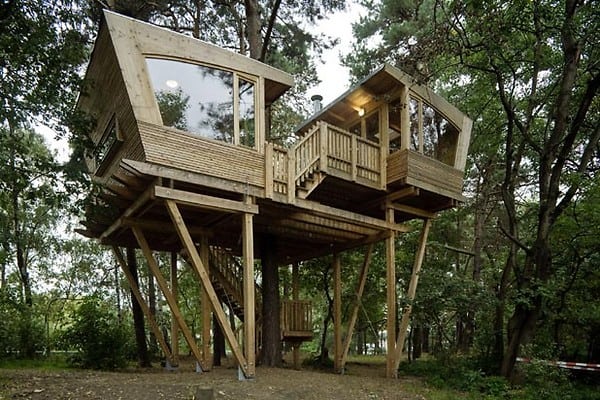
If you wander into Wolfsburg’s green edges and hear the low hum of laughter above the undergrowth, follow it. You’ll find the Scout Treehouse—part campsite landmark, part community love letter—risen from a partnership between the city of Wolfsburg and the VCP Wolfsburg scouts. It isn’t merely perched in the trees; it belongs to them, to everyone, in that generous, slightly scruffy way the best civic projects do.
From the ground, the architecture reads clear and confident: larch posts step up like a tidy grove of columns, lifting two sibling cabins and their terraces into the canopy. Twin forms, gently arched roofs—similar at a glance, not at all identical. One reveals a porthole window where the other keeps a long ribbon of glass; furnishings shift from sturdy benches to broad, communal tables. Personality, in duplicate.
The lower treehouse is the sleeping den: warm timber underfoot, bunks tucked like train berths, and enough room for up to eight tired scouts (or an equally enthusiastic family) to crash after a day of scrambling, knot-tying, and—you know it—campfire marshalling. It’s cozy, a little campy (in the literal sense), and exactly what you want at 22:00 when the night air turns crisp.
Climb a little higher and the mood changes from hush to gather. The upper treehouse is the social heart: a compact kitchen for one-pot wonders, a big dining table that’s never quite big enough for all the elbows and stories, and a wood-burning stove that turns shoulder seasons into bonus time. On cold mornings it’s the gravitational center—the place you drift toward with mugs in both hands.
A living ledge—just a meter above—extends the room into a perch with benches, an oven tucked close by, and views framed by the irregular geometry of trunks and beams. It’s rustic, yes, but also surprisingly considered: sightlines open, corners soften, details keep hands busy and spirits settled. The terrace railings—hand-friendly and scout-proof—invite loitering. Good design does that.
Look closely and you can read the collaboration. This is scout-built craft, refined with professional guidance (a nod to the design thinkers at Baumraum), and it shows in the honest joinery and the directness of the plan. No fussy ornament; nature’s already supplying it. Larch ages with dignity, the terraces float lightly, and the trees are respected as neighbors rather than load-bearing “solutions.” That matters. You can feel it.
And the use? Deliciously flexible. By day, it’s a meeting place, a classroom in leaves for knots, maps, and quiet bravery. By night, it flips to sleepover mode—roll mats unroll, stories lengthen, constellations get misnamed (with conviction). Families and small groups can book stays, too, borrowing the scouts’ vantage for a night or three. It’s democratic canopy living: safe, adventurous, gently unforgettable.
Ultimately, the Scout Treehouse is a design story told in soft voices: civic will, youthful hands, and an architecture that makes room for both. You arrive as visitors and leave as co-conspirators, pockets full of woodsmoke and a little more faith in what communities can build—literally—together.






Add a review