
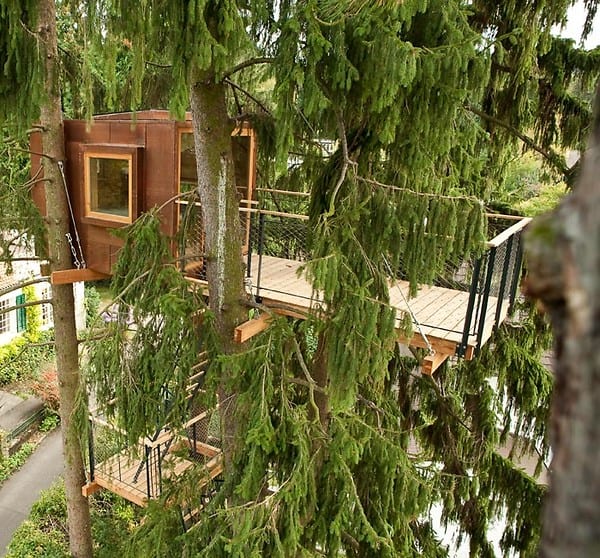
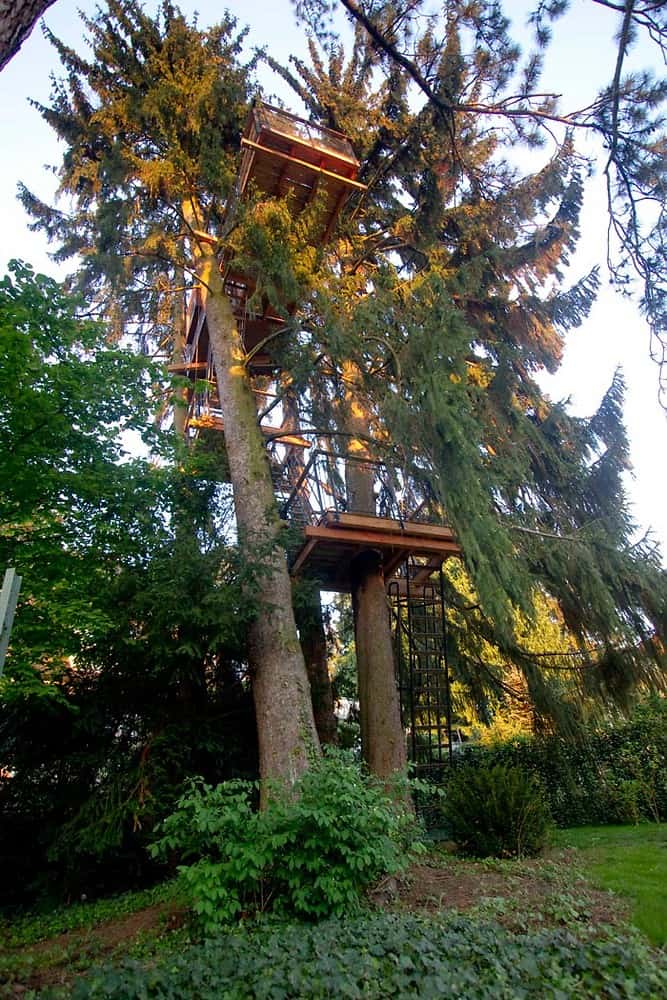
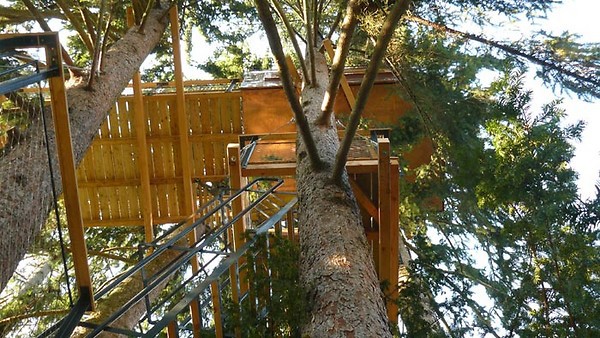
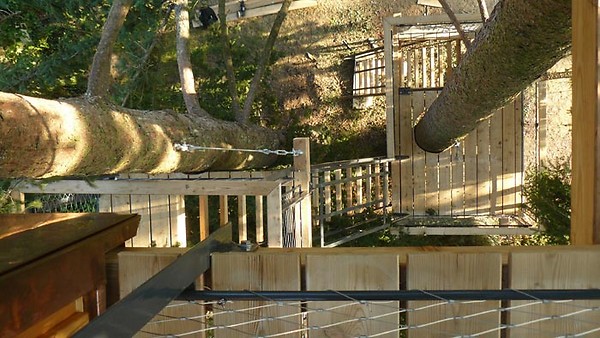
The ascent earns its reward. Climbing through the canopy of four Swiss firs, branches close in, resin sharpens the air, and the timber steps flex gently underfoot. Then the city breaks open. Basel's rooftops, the long curl of the Rhine, and on clear days the pale ridge of the French mountains resolve into a panorama that stops you mid-step. The Bàlvedere Treehouse sits at 12 metres above a Basel garden, conceived by its owner as a private lookout — a place to gain a higher horizon without leaving the city entirely.
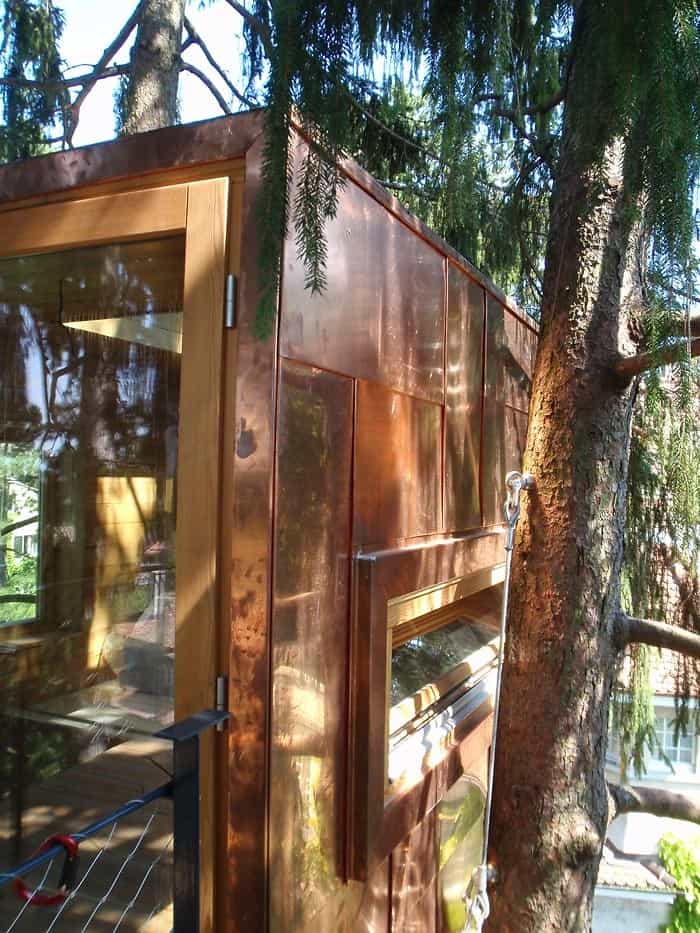
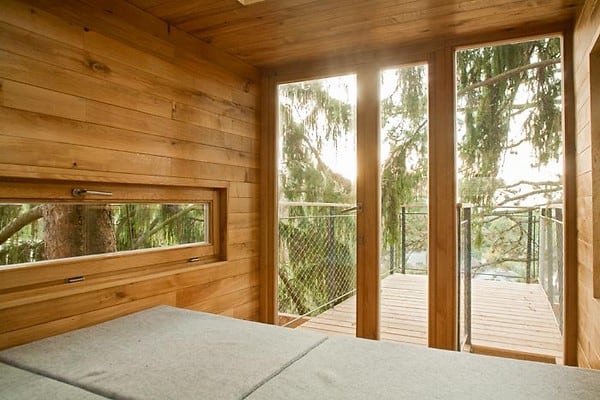
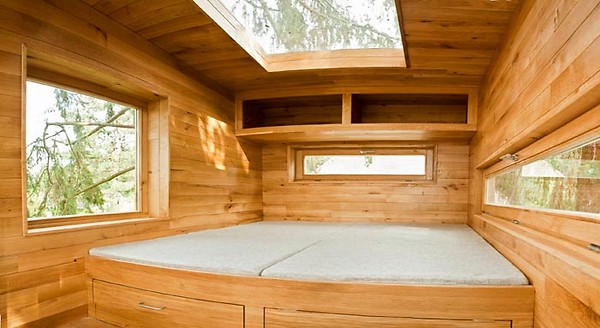
From below, the structure reads as a precise copper cube nestled in the upper canopy. The brightness is deliberate and temporary. Copper goes its own way over time, darkening and mottling toward green, until the cabin retreats visually into the firs around it. The effect is architectural patience: a bold statement that plans to become a quiet secret. Inside, the palette shifts from bright to warm. Oil-treated oak covers the floors and built-ins. Wool felt in slate grey absorbs echo and adds a particular hush. The restraint is purposeful — nothing competes with the glass.
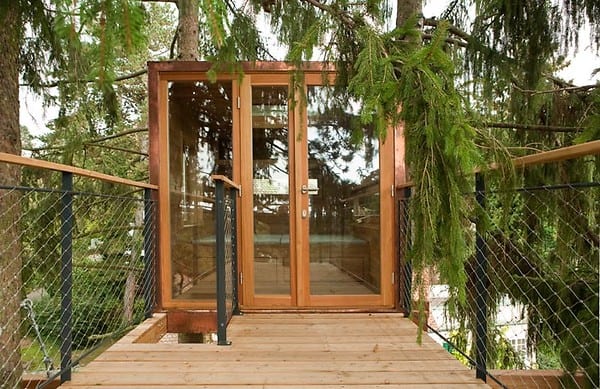
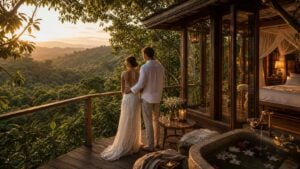
That glass does the real work. A full sliding wall opens the forest directly onto the terrace, while smaller apertures on every face, including overhead, compose a continuous 360-degree reel of sky, city and treetop. Sit anywhere in the room and a view finds you. The terrace itself feels like a floating room without walls, the firs leaning in close enough to make the height feel embraced rather than exposed.
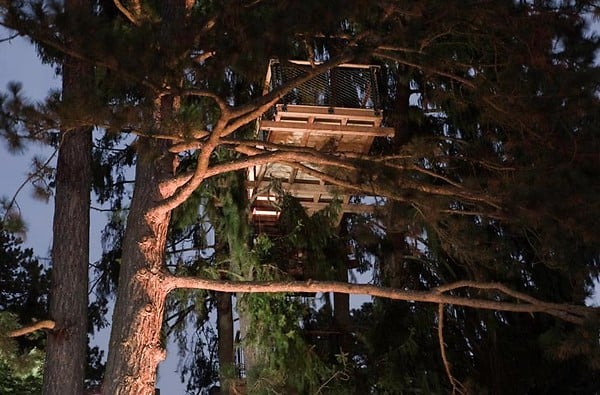
As daylight fades, the treehouse shifts register. Discreet lighting lifts each level — stairs, landings, terrace — like a paper lantern in the canopy. Below, Basel twinkles. The oak interior glows warm. Tram bells arrive as occasional punctuation, a soft seam of traffic drifts upward, and then the hush returns. The city is audible but not intrusive. It feels private without feeling hidden, removed without being remote.
Seasonally, spring and summer bring the experience into full expression. Warm days and long evenings make the terrace the obvious place to be, with views often sharp enough to catch the Alps on the horizon. Autumn softens the light and adds vineyard colour to the wider region — still comfortable, and well-suited to a design-led stay. Winter brings a different mood: cooler, occasionally snowy, and more cocooned, though terrace time naturally shrinks with the temperature.
Getting here is straightforward. The Schifflände tram and bus stop sits approximately 17 metres away in straight-line distance, served by trams 6, 8, 11, 14, 15, 16 and 17, along with buses 33, 34, 36 and 38. Visitors arriving from further afield will most likely land at Basel SBB, the main rail hub roughly 1.3 kilometres away in straight-line distance, with IC, ICE, EC and regional train connections across Switzerland, Germany and France.
Bàlvedere suits guests who come for a striking skyline and find, once they settle into the oak-and-felt interior with the city spread below, that they also came for something slower. It is a treehouse built by someone who understood that the best views reward patience — and that the architecture itself should be willing to wait.
Frequently Asked Questions
Q: Where exactly is the treehouse, and how do you get there without a car?
A: The Bàlvedere Treehouse sits in a Basel garden, 12 metres up in a canopy of four Swiss firs. The Schifflände tram and bus stop is approximately 17 metres away in straight-line distance, served by trams 6, 8, 11, 14, 15, 16 and 17, plus buses 33, 34, 36 and 38. Guests arriving by train will most likely come into Basel SBB, approximately 1.3 kilometres away in straight-line distance, which handles IC, ICE and EC rail services.
Q: What does the interior actually look like — is it rustic or design-led?
A: It leans firmly design-led. The floor and built-ins are oil-treated oak, acoustic wool felt in slate grey keeps the room quiet, and the hardware throughout disappears rather than draws attention. The exterior is a sharp copper cube that will slowly patina toward green over time — a deliberate architectural choice to let the cabin eventually blend into the canopy around it.
Q: What are the views like, and how much of the experience depends on the terrace?
A: The views are the centrepiece. A full sliding glass wall opens directly onto the terrace, and smaller apertures on every face — including overhead — deliver a continuous 360-degree reel of Basel rooftops, the Rhine, and on clear days the pale ridge of the French mountains. The terrace feels like a room without walls, with the firs close enough to feel embraced rather than exposed. Much of the stay's character shifts with the season and the light.
Q: When is the best time to visit for the full terrace experience?
A: Spring and early summer tend to offer the sharpest views, with warming days and long evenings ideal for spending time outdoors. Autumn brings softer light and vineyard colour across the wider region — still comfortable and well suited to a design-focused stay. Winter can be atmospheric if you enjoy a cocooned city escape, though cold temperatures naturally limit terrace time. Check conditions closer to your dates before planning around outdoor use.







Add a review