
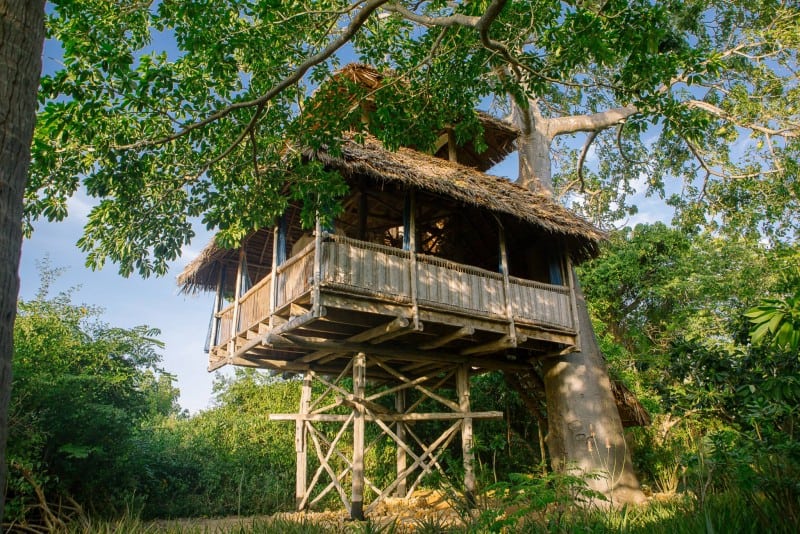
If you listen closely, the island starts talking long before you reach it. Waves brushing coral. The faint pop of mangroves. Then, somewhere behind all that, the creak of wood and rope — the sound of something human but older than you. That’s Chole Mjini. Seven treehouses, one on the ground, all built by hand. None identical. None quiet in spirit.
And then there’s Nne — the fourth, though the name feels bigger than that. Maybe “four” just means balance here. It’s the one everyone remembers, the one that breathes differently.
The story is simple enough: local craftsmen, hand tools, months of labor in a heat that doesn’t care what you’re building. Poles cut from island trees, cured slowly, ferried over by dhow, dragged through sand. No blueprints, just instinct. The kind of work where every nail gets a small prayer before it’s hammered in.
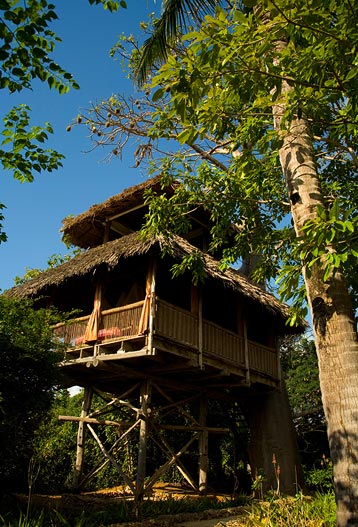
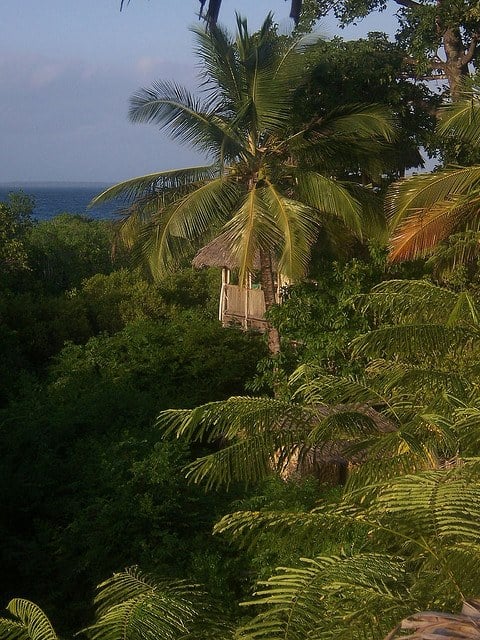
From the ground, Nne looks like it might float away. Three levels, all open to the air, no glass, no walls. The design borrows from Stone Town’s 19th-century tea houses — light, layered, full of air. You climb, and suddenly the sea opens in every direction. It’s not a view so much as a mood: pale turquoise by morning, deep copper by dusk, sometimes just fog.
Everything here invites you to slow down. Maybe that’s why the island birds fly like they’ve got nowhere urgent to be. You make coffee (slowly), you read two pages (slower), and before you know it, the tide’s turned and the light’s changed again.
The bathroom deserves its own paragraph. Locals joke that you’ll come down from the tree cleaner in spirit than in skin. The shower sits inside the old coral ruins, open roof, sun slicing through leaves. Lizards appear and vanish between stones. You wash in rhythm with them. Even the toilet has a window cut perfectly toward the canopy — bright, absurdly peaceful.
At night, the island hums. Fruit bats, waves, crickets. It’s busy, but never noisy. You lie in bed and realize you can feel the whole tree moving — just enough to remind you it’s alive and you’re its guest.
Chole Mjini doesn’t offer air-conditioning or room service, and that’s the point. What it gives you instead is a strange kind of clarity — the moment where you realize comfort was never really about control.
Come morning, sunlight filters through the floorboards and the ocean smells faintly of rust and salt. And for a beat, you think: maybe the world should always feel this unfinished, this alive.










Add a review