
Peru
Peru splits its treehouse offering between two landscapes that share almost nothing except the country's name: the humid Amazon basin around Tambopata and Madre de Dios, where you sleep at canopy height among macaws and morning mist, and the high Sacred Valley near Cusco, where thin mountain air, stone terraces and views toward snow-capped peaks define the wake-up call. One puts you in jungle chorus and boardwalk circuits; the other wraps you in wool blankets and wood smoke at altitude that makes your lungs remember they have a job.
{{locationDetails}}
Browse sub-categories


About Peru
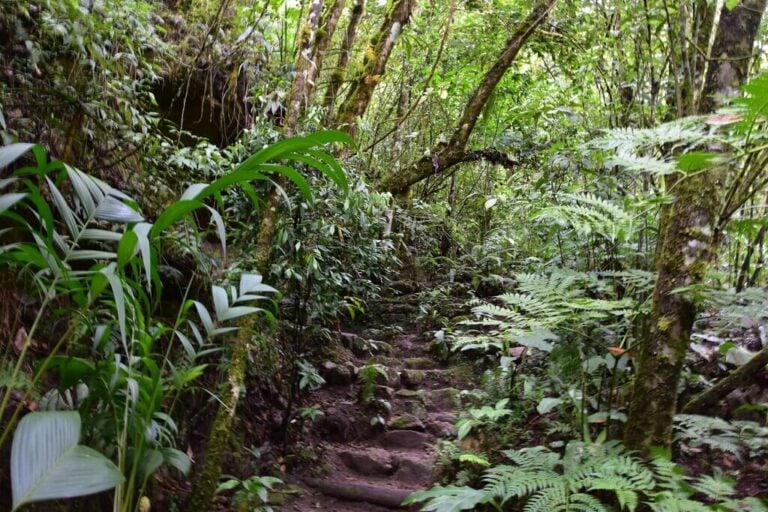
Peru puts treehouses in two utterly different places, and the difference between them is half the reason to go. In the Amazon basin—Tambopata, Madre de Dios, the outer edges of Manu—you're sleeping in humid air thick enough to taste, waking to the racket of macaws at a clay lick and the quiet understanding that something with more legs than you is sharing the vicinity. In the Sacred Valley near Cusco, the air is thin and cold at dawn, the light is sharp on terraced hillsides, and the treehouse feels like a wooden aerie tucked into eucalyptus and stone walls older than your great-grandmother's vocabulary.
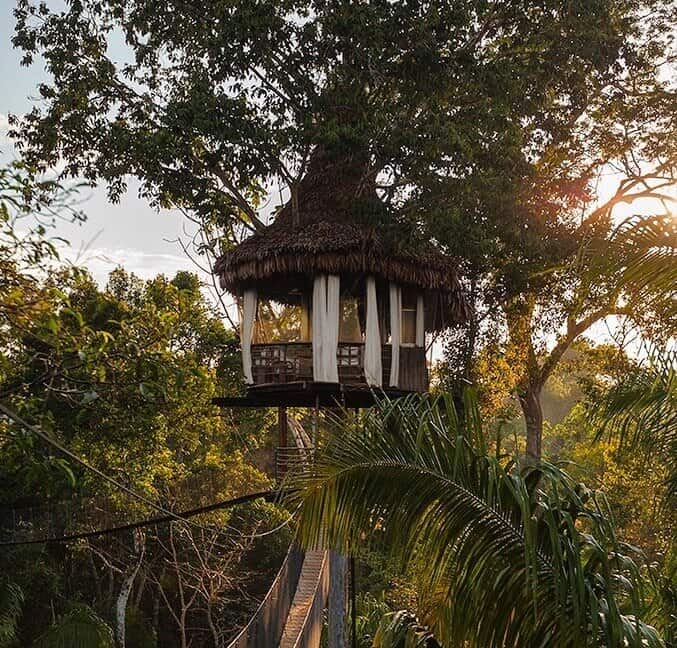
Amazon lodges put you at canopy height, which means eye level with bromeliads, the occasional sloth moving like a philosophical argument, and parrots that have no interest in your photography schedule. Nights here arrive with a chorus: tree frogs ticking, cicadas insisting, rivers moving somewhere below in the dark. Days tend to start with a boat ride across still water—Lake Sandoval is a frequent early-morning destination—and guides who can tell you what made that splash you heard but will also let you sit quietly if that's what the morning needs. Hoatzins show up, prehistoric and faintly ridiculous. The forest is loud, then quiet, then loud again in ways you won't predict.
The Sacred Valley treehouses live at altitude, surrounded by peaks that hold snow most of the year and fields that shift between barley, quinoa, and pasture depending on the season. You're an hour from Cusco, two hours from Machu Picchu, and firmly in the orbit of Inca stonework and wool blankets heavy enough to stop a small vehicle. Mornings here are coca tea, wood smoke, and cold air that makes your lungs work a little harder. The treehouse itself is often built with local hardwoods, adobe foundations that hold warmth, and carved shutters that feel like someone's grandfather made them on purpose.
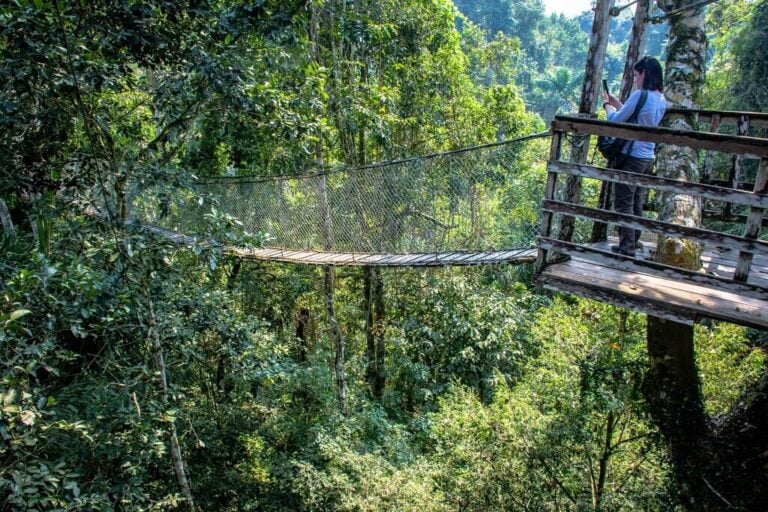
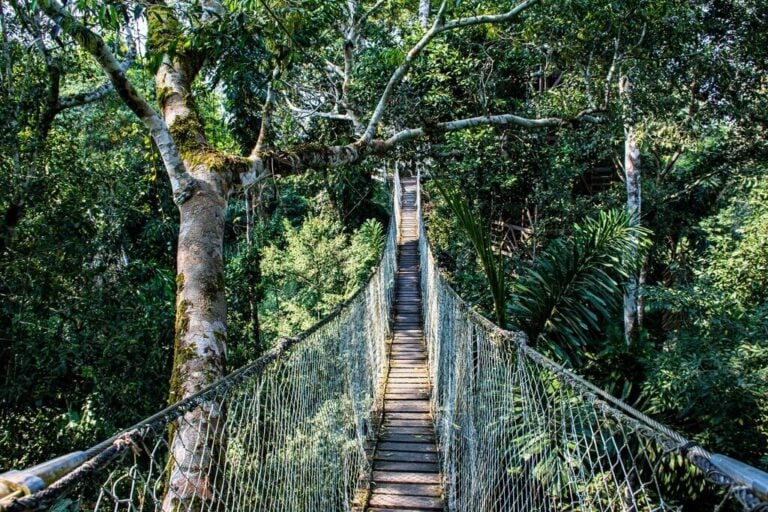
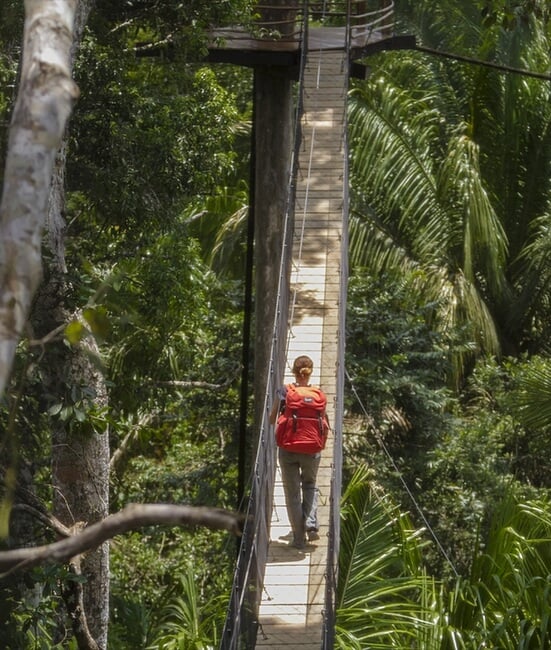
Most Peru treehouses lean toward smaller operations rather than resort sprawl: solar panels tucked out of sight, rainwater systems, boardwalks that curve around tree roots instead of cutting through them. The amenities tend to stop at hot water and a decent mattress; the attraction is the view, the altitude, and the fact that you're sleeping in a tree in a country that takes both jungles and mountains seriously. May through October is the reliable window for Amazon stays—dry season, easier trails, lower water. The Sacred Valley is clearest April through October, though June through August brings crowds to Machu Picchu and the surrounding circuits. Most lodges want you for at least two nights, and advance booking is wise if you're traveling during the dry-season overlap.
Pairing a treehouse stay with the rest of a Peru itinerary is straightforward enough: fly into Lima, connect to Puerto Maldonado for the Amazon, then route back through Cusco for the highlands. Or reverse it. The two regions don't resemble each other, which is the point. You arrive with a suitcase and leave with the memory of waking up twice—once to howler monkeys, once to frost on a tin roof—and the oddly grounding realization that Peru does elevation in every sense, and so, briefly, did you.
Frequently asked questions about Peru
What are the two main regions for treehouses in Peru?
Peru treehouses cluster in two very different climates: the Amazon basin (Tambopata, Madre de Dios, Manu) where you sleep in humid jungle at canopy height surrounded by macaws and river sounds, and the Sacred Valley near Cusco where treehouses perch at altitude in dry mountain air with views of Inca terraces and snowcapped peaks. The Amazon is hot, loud, and green; the Sacred Valley is cold at dawn, quiet, and built from stone and eucalyptus. Most travelers pick one or route through both on a longer trip.
When is the best time to visit treehouses in Peru?
May through October is dry season and the most reliable window for both regions. In the Amazon, dry season means easier trails, better wildlife spotting, and lower water levels; the rainy months from November to April can close some lodges and make access difficult. The Sacred Valley is clearest April through October, though June to August brings the heaviest crowds to Machu Picchu and surrounding areas. If you're planning both jungle and highlands, aim for the May to September overlap.
Can you combine a treehouse stay with a trip to Machu Picchu?
Yes, and most people do. A typical route is Lima to Puerto Maldonado for two or three nights in an Amazon treehouse, then fly to Cusco and spend another few nights in the Sacred Valley before visiting Machu Picchu. You can also reverse the order. The two regions are different enough that pairing them makes sense: jungle mornings with howler monkeys, then highland mornings with frost and thin air. Just build in travel days between the Amazon and Cusco.
What can you expect to see and do at an Amazon treehouse in Peru?
Early-morning boat trips across still water to watch macaws gather at clay licks, guided jungle walks where you learn what made that splash in the dark, and canopy-level views of sloths, parrots, and bromeliads. Nights arrive with tree frogs, cicadas, and rivers moving below. Most Amazon lodges include a naturalist guide in the package, since Peruvian reserves require them. Days tend to be a mix of scheduled wildlife outings and time to sit quietly on your deck while the forest does its loud-then-quiet-then-loud-again routine.
Are Peru treehouses rustic or comfortable?
They lean toward comfortable simplicity rather than luxury resort amenities. Expect hot water, a decent mattress, and often solar power and rainwater systems managed quietly in the background. Amazon lodges are built for function in humid conditions: screened walls, ceiling fans, boardwalks that navigate roots. Sacred Valley treehouses use local hardwoods, adobe foundations that hold heat, and wool blankets heavy enough to matter at altitude. The attraction is the location and the view, not the thread count.