
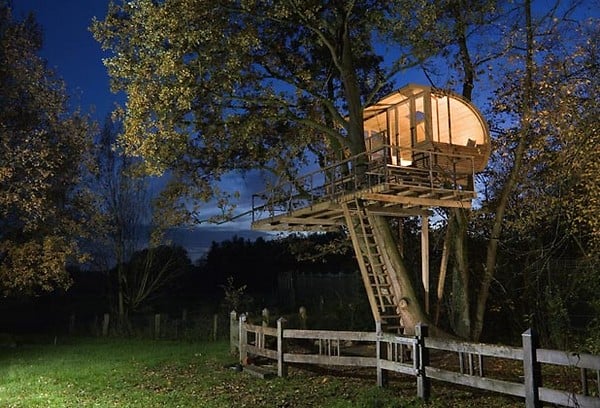
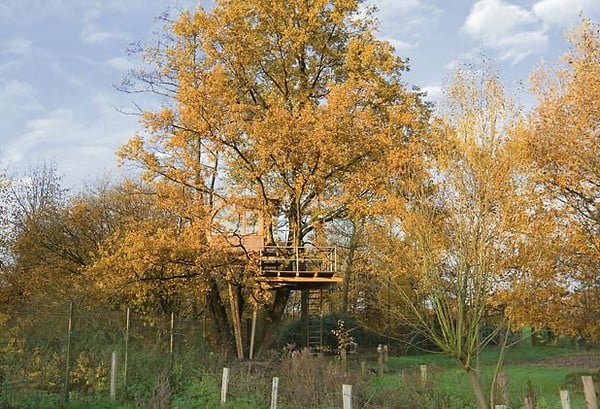
Zwischen Erle und Eiche translates simply as "Between Alder and Oak." It is a rare case where a name does the work of a brochure. This small, architecturally considered treehouse sits in the canopy near Osnabrück, in the quiet green of North-West Germany, lodged quite literally between the two trees that give it its name.
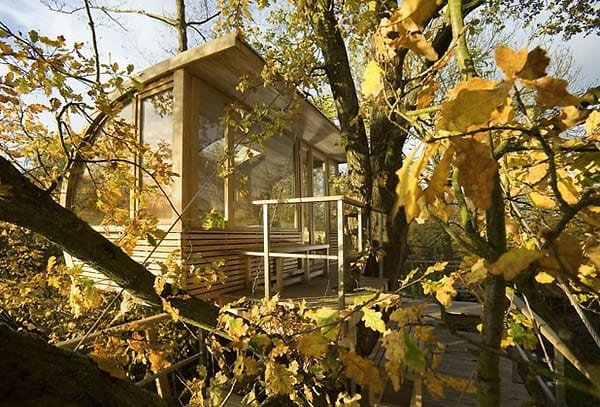
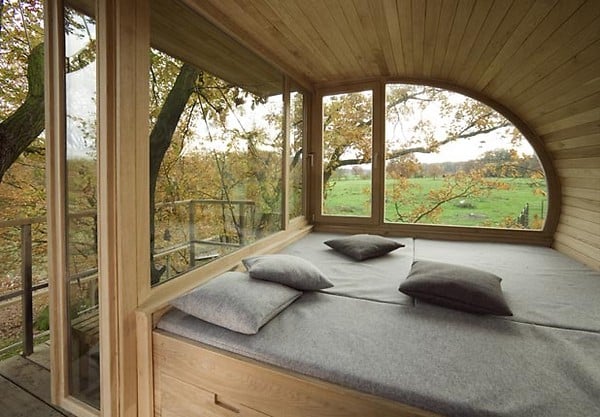
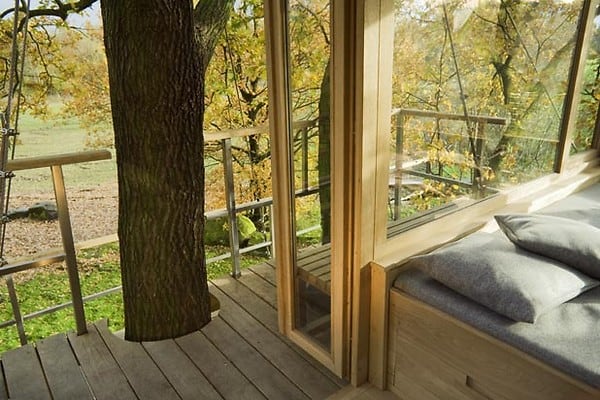
The first detail that distinguishes it is the roof. Rather than a standard pitch or a flat deck, it curves in soft, flowing waves — an unusual design choice that echoes the organic shapes of the canopy above rather than imposing on them. Alongside that, glazing runs across every elevation, with a generous dormer window above. On clear mornings the light comes in at angles. On overcast days the glass draws the mist inside and the forest feels very close.
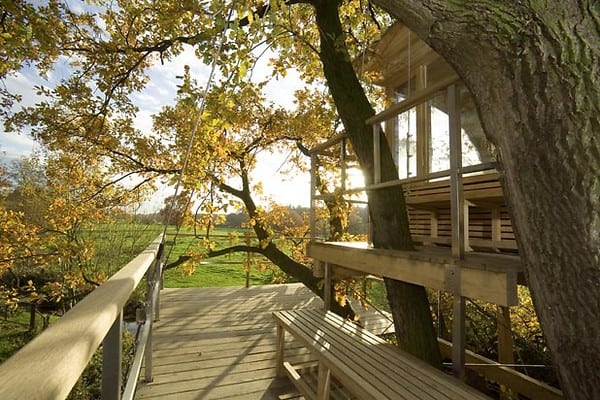
The experience unfolds across two levels. A crafted staircase leads up to a small terrace first — a table, a pair of chairs, and a view into the trees at a height that changes how the surrounding woodland reads. It is the kind of spot that discourages a schedule. Then the main cabin sits a further metre above, and that single step in elevation matters more than it sounds. The light shifts, the canopy opens slightly, and the separation from the ground feels complete.
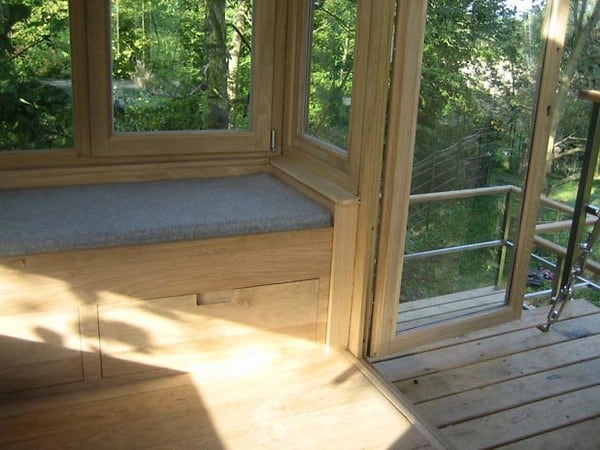
Inside, the approach is deliberate reduction. A generous lying area takes up one side — the obvious invitation is to stretch out and stay there. Opposite sits a bench. Beneath the floor, drawers cut from oak handle the practical need for storage without cluttering the space. There is no effort to pack in amenities. The design logic is coherent: less inside means more attention goes to what is outside.
Zwischen Erle und Eiche does not compete on comfort features. It competes on atmosphere and design coherence. The wave roof, the layered levels, the oak detailing and the unbroken glazing all work toward the same end — a stay that feels considered rather than assembled. It suits visitors who want architecture and nature at the same time, not those looking for a fully equipped forest retreat.
Getting there by public transport is straightforward. Osnabrück Altstadt station sits approximately 80 metres away and connects regional train lines RB58, RB61, RE18, RE60 and RE62, making it the most practical arrival point. The Nonnenpfad bus stop is roughly 70 metres away and serves bus lines 14 and 15 for local connections. A short distance further, the Vitihof stop adds bus lines M1, M5 and the night routes N1, N5 and N18 for broader city access.
Frequently Asked Questions
Q: What makes this treehouse architecturally unusual compared to most treehouse stays?
A: The most distinctive feature is the wave-curved roof — neither flat nor pitched, but flowing in soft curves that echo the canopy rather than interrupting it. Panoramic glazing on every elevation and a dormer window above mean the surrounding forest is essentially the interior's main feature, shifting from golden on clear mornings to misty and atmospheric on overcast days.
Q: Is this treehouse suited to guests looking for lots of amenities and activities?
A: No — and that's by design. The interior is deliberately spare: a generous lying area, a bench, and oak-carved storage drawers beneath the floor. There is no attempt to pack in comfort features. It suits visitors who want design, stillness, and close contact with the canopy; those expecting a fully equipped forest retreat will likely find it too minimal.
Q: How does the two-level layout work in practice?
A: A crafted staircase leads first to a small terrace with a table and chairs — a natural pause point in the treetops. The main cabin sits roughly a metre higher still, which shifts the sightline above the immediate undergrowth and into the mid-canopy. That single step in elevation is a deliberate design choice, not just an aesthetic one.
Q: How easy is it to reach without a car?
A: Public transport access is genuinely practical. Osnabrück Altstadt station is approximately 80 metres away, serving several regional train lines. Two bus stops within short walking distance add local and city-wide connections, including night routes.
Q: What kind of stay is this best suited for?
A: Short escapes focused on quiet and design rather than sightseeing or activity. The architecture rewards slow mornings and unhurried time in the canopy. It works well for couples or solo travellers who want considered surroundings rather than entertainment or amenities.








Add a review