

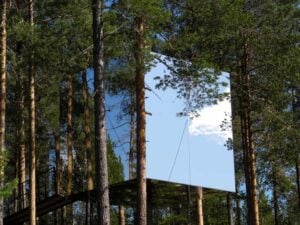
Walk into the Fiskars pines and look up. Six metres above the forest floor, a dark capsule sits quietly among the branches — easy to miss until it isn't. This is KOJA, a micro treehouse designed by Finnish architect Kristian Talvitie and realised in collaboration with Polestar. Its name means hut or den in Swedish, and the word is exactly right: small, purposeful, and entirely yours.
The structure wraps the trunk without a single bolt through living wood. That choice sets the tone. A panoramic glass façade opens the forest into the room, and a central skylight draws daylight straight down through pale timber. Watch the clouds pass and you actually feel time slow. The dark exterior shell — local timber finished in deep tones — lets the capsule slip back into the canopy. From below, it almost vanishes.
Materials tell the story quietly. Locally sourced timber and Finnish wool keep the palette warm and the carbon footprint honest. Sustainability here isn't a certificate on the wall; it's the floor beneath your feet and the insulation pressing against the cold. Talvitie and Polestar share a design language — clean lines, low impact, nothing wasted — and KOJA is where that language becomes a room you can sleep in.
Inside, the space is U-shaped and adaptable. It converts from a lounge to a bed for two, with storage tucked into every sensible corner. There's room for a thermos, a paperback, and the pinecone you'll inevitably carry in. A separate bathroom sits a short walk from the hut, keeping the footprint trim while ensuring real comfort. Bring slippers. The walk between buildings through the night air is part of the experience — pine needles underfoot, the smell of resin, no signal worth worrying about.
KOJA made its debut at the Fiskars Village Art and Design Biennale as part of the "House by an Architect" exhibition. That context still shapes how it feels: less holiday rental, more considered argument about how we might travel. Polestar's influence runs through the ethos as much as the engineering. If electric cars can be reimagined from first principles, why not cabins? The question hangs pleasantly in the air.
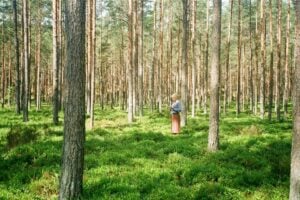
Summer, from June to August, brings warm Nordic evenings, lake swims and long light through that panoramic glass — temperatures typically reaching the low twenties. Autumn sharpens the view with golden foliage and crisp air, and winter turns the forest into frosted silence, with temperatures well below zero and a kind of quiet that feels earned. Any season rewards the slow-travel instinct KOJA is built around.
Reaching Fiskars by public transport is straightforward from the Helsinki direction. Karis station, served by train lines 1 and H, sits approximately ten kilometres away. Local bus stops at Slickovägen S and Slickovägen N are each around 600 metres from the site, making the final stretch easy to cover on foot or by arrangement with the host.
KOJA suits couples, design-curious travellers, and anyone who wants a night that feels genuinely considered rather than performatively eco. The Fiskars Village galleries and coffee spots sit within easy reach below. Climb back up when the light turns honey-gold. Go less far, stay longer, listen harder — KOJA makes the argument well.
Frequently Asked Questions
Q: How is KOJA attached to the tree, and does the construction harm the tree?
A: The structure wraps around the trunk without any bolts through living wood — a deliberate design choice by architect Kristian Talvitie that keeps the host tree intact. It's one of the features that makes the build distinctive.
Q: What is the sleeping arrangement inside KOJA?
A: The interior is U-shaped and convertible — it functions as a lounge during the day and a bed for two at night, with storage tucked into the compact layout. It's designed for two guests who travel light by choice or necessity.
Q: Is there a bathroom inside the treehouse?
A: The bathroom is separate, a short walk from the hut itself. This keeps KOJA's footprint small while still providing real comfort. Check the host's current listing for exact details before booking.
Q: When is a good time to visit KOJA?
A: Summer (June–August) suits those after long Nordic evenings, lake swims and warm light through the panoramic glass. Autumn brings golden foliage and crisp air ideal for photography and hiking. Winter offers frosted pines and deep quiet for a genuinely slow escape — though temperatures drop well below zero, so pack accordingly.
Q: How do I reach Fiskars by public transport?
A: Karis station, served by train lines from the Helsinki direction, is approximately ten kilometres from Fiskars. From there, local bus services cover the remaining distance. Confirm current timetables before travel.








Add a review