

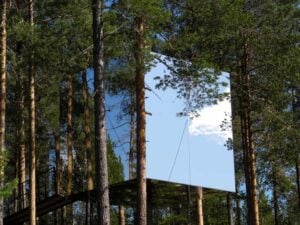
Look up through the circular skylight and the sky does the rest. On a clear Dalarna night, stars crowd the glass; in winter, a curtain of green can appear without warning. This is the central pleasure of the Supermåne treehouse at Näsets Marcusgård — a cable-suspended dome slung between two pines near Furudal, named for the supermoon, and built to make that name feel earned. The outer shell combines fumed ash and aluminium accents, hung on high-tensile cables with an almost aeronautical logic. Inside, the mood shifts from engineering to warmth.
The interior rewards slow mornings. Underfloor heating takes the edge off cold nights, and a compact wood stove adds the kind of flickering light that makes every book feel better. The sofa converts to a double bed with a single satisfying motion; a smaller single suits a child or an overpacked bag. Cushions end up wherever they're needed. The dome amplifies small sounds — stove pings, the zipper of a jacket — and that intimacy is part of what makes the place feel genuinely apart from the world.
The stay shifts with the seasons, and the property rewards repeat visits. Summer brings long Nordic evenings, resin-scented air and outdoor cooking beside the dome. Autumn edges the forest into colour and opens the first real window for aurora sightings. Winter is when the barn comes into its own: a refurbished building with a proper kitchen, a private hot shower and a wilderness sauna that earns its reputation. Deep cold also means frozen lakes for skating, dark skies for stargazing and, if the timing is right, the northern lights visible from bed. Spring arrives quietly, melting snow giving way to bright, cool mornings and lively forest trails. Linens and towels are provided throughout the year.
Supermåne sleeps two adults and one child, but Näsets Marcusgård offers more than a single glowing dome. Wander a short way and you reach Oddis Öga — an elliptical timber pod whose signature circular window frames the surrounding forest like a still painting. For larger groups, the farm's restored suites step up: Hölada accommodates six and Fähus eight. Across the property, guests find a pool that captures whole afternoons, a trampoline, and hosts whose attentiveness guests tend to mention unprompted.
Dalarna frames everything here beautifully. Red barns break up long stretches of pine. The lakes lie flat as mirrors in summer and freeze into clean geometry in winter. Moose, fox and owl move through the blue hours if you're patient. Furudal wears its folklore lightly, with trails edged by lichen older than any building in sight. Nightly rates for Supermåne run approximately 2,750–3,250 SEK, with prices varying by season and availability — a premium tier that reflects the property's considered design and setting.
For visitors arriving by public transport, Furudal train station is the primary access point at approximately 1.8 km straight-line distance. Hedlunds bus stop, served by bus lines 345 and 351, sits approximately 1.9 km away. Oreborg bus stop, on bus line 345, is approximately 2.1 km from the property. These are approximate straight-line distances rather than measured walking routes. Arriving by car gives the most flexibility for reaching the property and for exploring the wider Dalarna countryside.
Pack layers regardless of season. Bring a headlamp for the path between the dome and the barn. Allow a morning with no plan. The Supermåne treehouse is the kind of place where the duvet counts as an activity, the stove earns its keep, and looking up through the skylight before sleep becomes the one habit worth keeping.
Frequently Asked Questions
Q: What is the nightly rate for Supermåne?
A: Rates run approximately 2,750–3,250 SEK per night, placing Supermåne in the premium tier. Prices vary by season and availability, so check the property's booking page for current figures.
Q: When is the best time to visit for Northern Lights viewing?
A: Autumn through winter — roughly September to March — offers the strongest aurora chances, with November to March bringing the darkest skies and snow-covered surroundings. Summer has its own appeal: long Nordic evenings and excellent stargazing through the circular skylight, though aurora sightings are rare then.
Q: How many guests does Supermåne sleep?
A: The dome comfortably sleeps two adults and one child. The sofa converts to a double bed, with a separate single suitable for a younger guest.
Q: Where do guests access shower and cooking facilities in winter?
A: In colder months, a refurbished barn on the property provides a proper kitchen, private hot shower and a wilderness sauna. Linens and towels are included year-round.
Q: Is Supermåne suitable for a group larger than three?
A: The dome itself suits two adults and one child, but Näsets Marcusgård offers companion stays nearby — Oddis Öga is a smaller elliptical pod, while the farm suites Hölada and Fähus accommodate six and eight guests respectively.





Add a review