
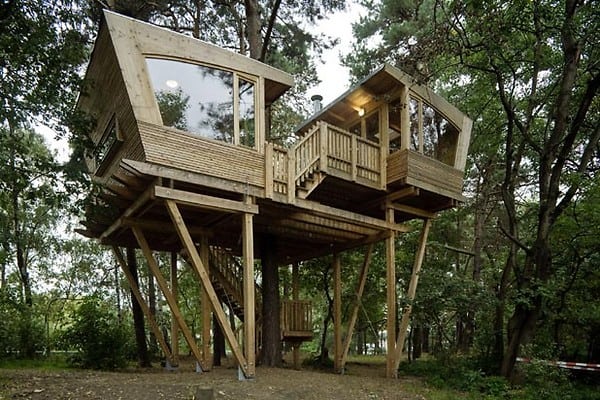
At Volkmarsdorfer Str. 100 on the quieter edge of Wolfsburg, two larch-post cabins rise into the canopy side by side. They look related at a glance — gently arched roofs, generous terraces, honest timber — but each has its own character. This is the Scout Treehouse, a collaboration between the city of Wolfsburg and the VCP Wolfsburg scouts, and it carries that joint authorship openly. The craft is visible in the joinery. The intention is visible in the design.
From the ground, the structure reads clearly. Larch columns lift both cabins above the undergrowth, and the trees themselves are treated as neighbours rather than structural conveniences. One cabin has a porthole window; the other offers a long horizontal pane. Small differences, but they matter. They give a place built for groups something that feels personal rather than institutional.
The lower cabin is the sleeping den. Bunks sit tucked like train berths, the timber floor stays warm underfoot, and the space fits up to eight comfortably. It suits a scout troop at the end of a full program day, or a family that wants genuine outdoor immersion rather than a glamped-up approximation of it. At night, with the tree canopy overhead and the day's woodsmoke still in the air, it delivers exactly the right atmosphere.
Climb to the upper cabin and the mood shifts from quiet to communal. A compact kitchen handles simple one-pot cooking. A broad dining table anchors the room, and a wood-burning stove makes the space genuinely usable into the shoulder seasons. A covered terrace — a living ledge just a metre above — extends outward with benches and an oven nearby, sightlines opening through trunks and beams. Groups drift here naturally, mugs in hand. It is the gravitational centre of the stay.
The design carries professional refinement alongside its scout-built roots. Details are considered: terrace railings are hand-friendly and sturdy, corners feel softened rather than sharp, and the overall plan is direct without being spartan. Larch ages with dignity and the structure sits lightly in its setting. Nothing here feels over-engineered or over-decorated. Nature is doing enough of the visual work.
The venue works across a wide range of uses. By day it functions as an outdoor classroom — knots, navigation, group programs, quiet skill-building. By night it becomes a sleepover destination, with roll mats unrolled, stories stretching long, and stars misidentified with great confidence. Families and small groups can book stays alongside scout organisations. Late spring through early autumn, roughly May to September, brings mild temperatures and long days that suit overnight stays and outdoor workshops best. High summer fills the upper terrace and sleeping cabin to full effect. Cooler shoulder months remain workable for groups willing to lean on the wood-burning stove and embrace the quieter pace.
For access, the bus stops at Almke Freibad and Kapellenstraße sit approximately 600 m and 800 m away respectively. Travellers arriving by rail can reach the area via Oebisfelde station, served by train lines RB 35, RB 36, RE 6 and RE 35, roughly 13 km from the site. Most groups arriving for a residential stay will find the journey easiest by car, but rail connections into the wider Wolfsburg area remain a practical option for those travelling from further afield.
Frequently Asked Questions
Q: Who can book the Scout Treehouse — is it only for scout groups?
A: Scout organisations are the primary users, but families and small groups can also book overnight stays and day programs. The venue was built as a joint project between the city of Wolfsburg and the VCP Wolfsburg scouts, which gives it a civic, open character rather than a members-only feel.
Q: How many people can sleep here, and how is the sleeping space arranged?
A: The lower cabin sleeps up to eight, with bunks arranged in a compact, train-berth style on a warm timber floor. It suits a scout troop after a full day outdoors or a family looking for genuine outdoor immersion.
Q: What is the best time of year to stay?
A: Late spring through early autumn — roughly May to September — is the prime window, with mild to warm temperatures, long days and leafy surroundings well suited to overnight stays and outdoor workshops. High summer makes full use of the upper terrace and sleeping cabin. The wood-burning stove in the upper cabin extends comfortable use into the cooler shoulder months of March–April and October for groups happy to layer up.
Q: What communal facilities are available for groups?
A: The upper cabin functions as the social hub, with a compact kitchen for simple cooking, a broad communal dining table, and a wood-burning stove. A covered terrace extends the space outward with benches and an oven nearby — it tends to become the natural gathering point during a stay.





Add a review