

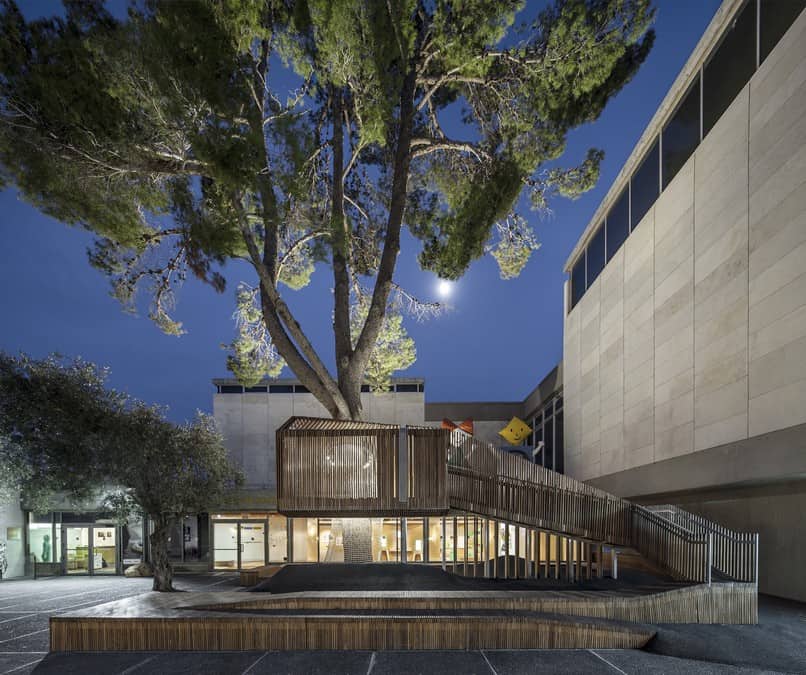
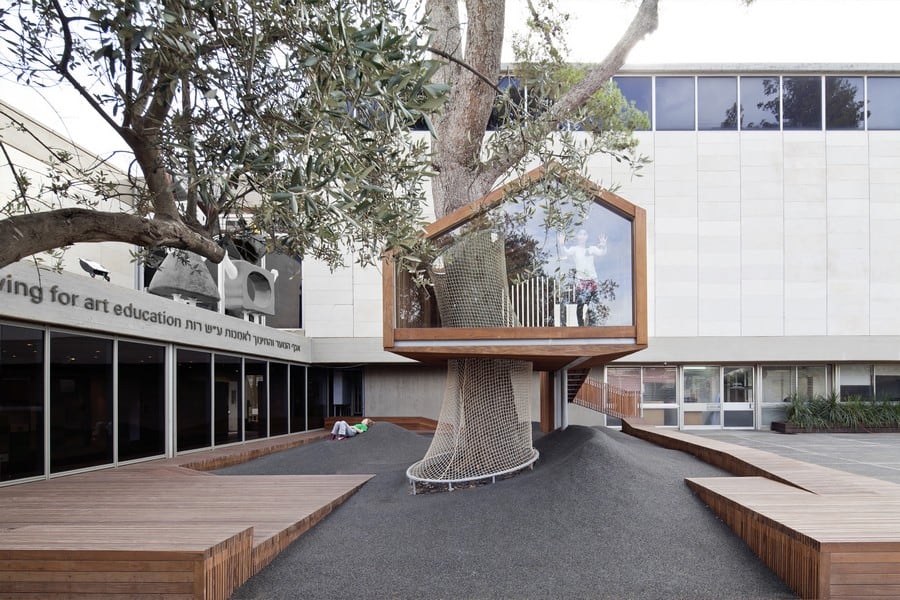
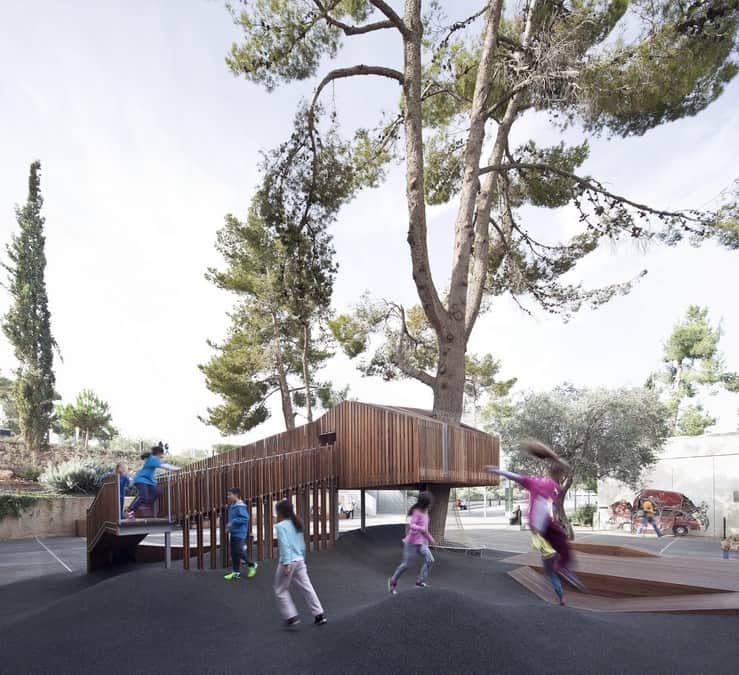
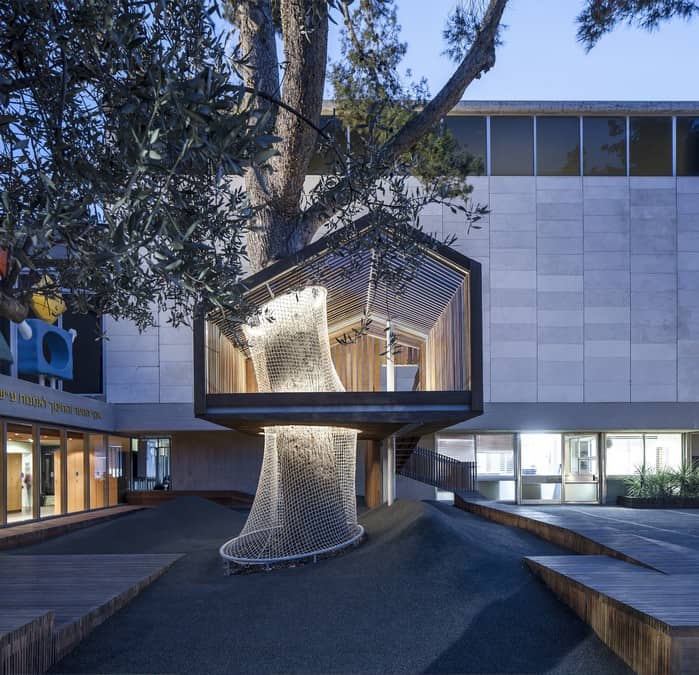
At the entrance to the Israel Museum's Youth Wing, a single pine tree leans slightly off-centre — and everything else arranges itself around it. The treehouse structure designed by architects Ifat Finkelman and Deborah Warschawski treats that lean not as an obstacle but as the entire premise. The result is something rare: permanent treehouse architecture within one of the world's great cultural institutions, built at full scale from a child's sense of wonder.
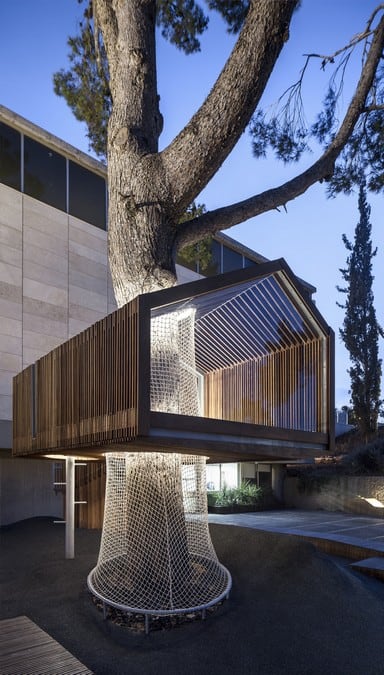
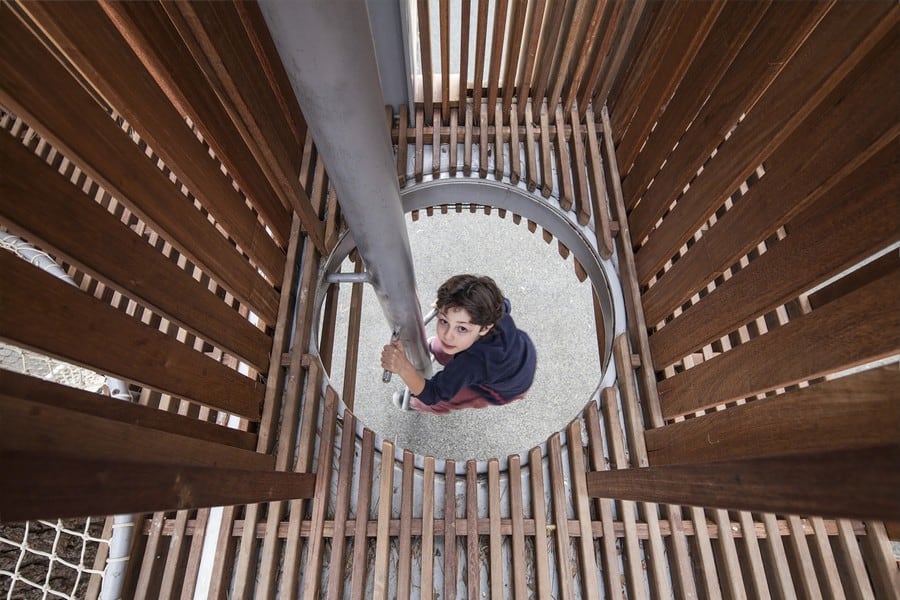
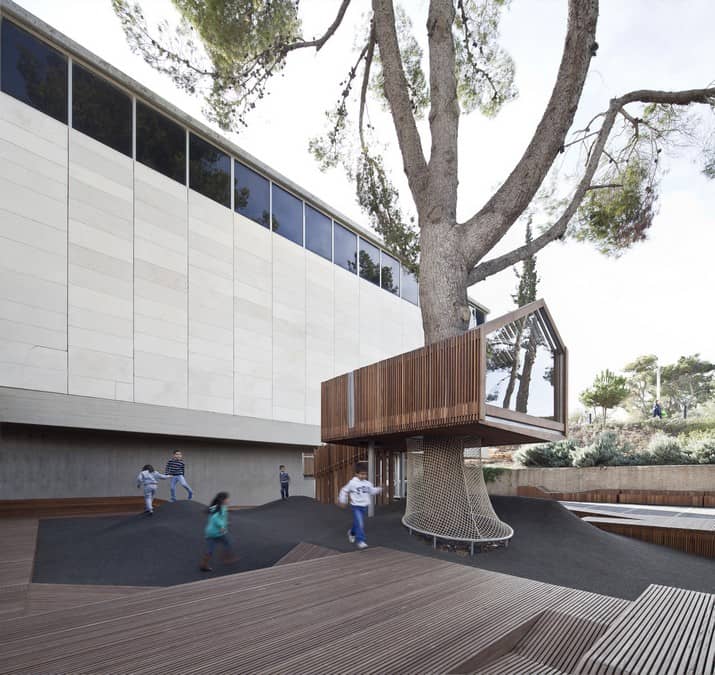
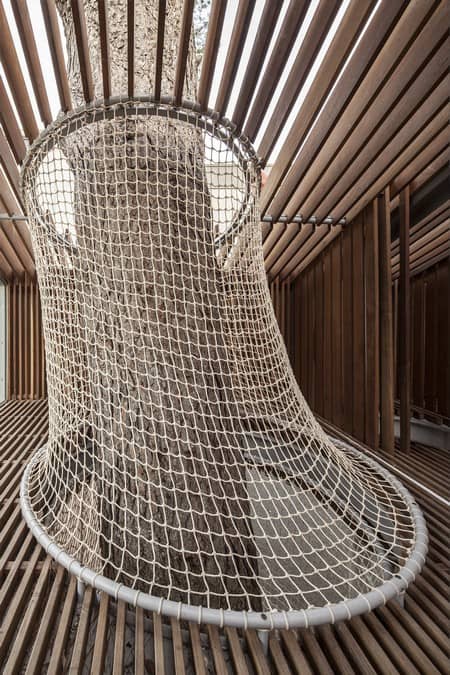
The form winds through the courtyard in a looping ribbon of timber and steel. Thin ipe wood boards, only a centimetre or two thick, wrap a lightweight steel skeleton and are spaced so that light filters through in gradients — dense and sheltered near the top, open and airy below. The structure doesn't announce itself loudly. It folds into the courtyard the way a good hiding place does: gradually, invitingly, almost by accident.
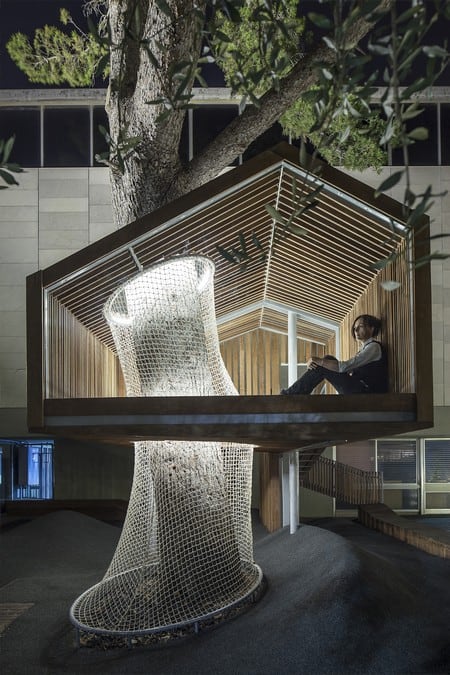
Where the installation presses closest to the pine's tilted trunk, a small roofed alcove appears. It is sized for children. From inside, they can peer through narrow timber slats at the museum grounds beyond — half-hidden, half-thrilled, entirely absorbed. That particular nook captures what the whole project is reaching for: the sensation of claiming a tree as your own.
Descending toward ground level, the structure shifts character entirely. What begins as architecture becomes landscape. Seating steps rise from a surface of soft EPDM rubber — cushioned for children, but also carefully designed to protect the pine's root network below. The practical necessity disappears into the play. You notice the ease it creates, not the problem it solved.
By day the courtyard hums with motion: children running circuits, parents in patches of shade, students with sketchbooks. The installation earns its keep with families throughout museum opening hours. At dusk the tone changes. Subtle lighting beneath the timber panels makes the structure glow from within, turning the treehouse into a lantern at the museum's threshold. Catching it at both times of day rewards the visit.
Spring and autumn are the most comfortable seasons for the courtyard. March through May brings mild, clear days and soft light ideal for outdoor exploration. October and November offer warm afternoons with a golden quality that suits the timber tones of the structure well. Summer midday visits can be hot; the shaded alcove and indoor galleries of the Youth Wing offer relief. Winter rain makes the outdoor spaces less welcoming, though the museum's interior exhibitions remain a strong draw year-round.
The Youth Wing entrance courtyard suits design-curious families, architecture enthusiasts and anyone drawn to the intersection of landscape, play and public art. It won't offer a night's sleep, but as an example of what treehouse thinking can achieve in an institutional setting — poetic, considered, rooted in a real tree — it belongs on any serious list of notable treehouse architecture.
The Israel Museum sits on Derech Ruppin in Jerusalem's Givat Ram neighbourhood. Kiryat Moshe station, served by light rail line L1, sits approximately 1.2 km away in straight-line distance and offers a practical approach from the city's western neighbourhoods. Jerusalem – Yitzhak Navon train station is approximately 1.3 km away and connects the museum precinct to the national rail network. Both distances are approximate; visitors should check current routes and schedules locally. The museum also has on-site parking for those arriving by car.
Frequently Asked Questions
Q: Is this a place to stay overnight, or a daytime visit?
A: The Youth Wing Entrance Courtyard is a permanent public installation at the Israel Museum — a daytime experience, not accommodation. The treehouse structure by architects Ifat Finkelman and Deborah Warschawski is free to explore during museum opening hours.
Q: Is it suitable for young children?
A: Yes — the installation is genuinely designed with children in mind. A small roofed alcove scaled for kids tucks against the leaning pine, and the ground-level seating steps sit on soft rubber cushioning. Families with young children are a natural fit for this space.
Q: When is the best time of year to visit the courtyard?
A: Spring (March–May) offers mild, clear days and comfortable temperatures well suited to exploring the outdoor installation. Autumn afternoons in October and November are warm with a golden quality that suits the timber tones of the structure. Summer midday can be hot, so pairing the courtyard visit with time in the indoor galleries helps. Winter rain makes the outdoor space less inviting, though the museum's interior remains worth the trip year-round.
Q: How do I reach the Israel Museum by public transport?
A: Jerusalem – Yitzhak Navon railway station is approximately 1.3 km away, and the Kiryat Moshe light rail stop on line L1 is around 1.2 km from the museum. Check current timetables before travelling.
Q: Is the courtyard worth visiting after dark?
A: At dusk, subtle lighting beneath the timber panels makes the structure glow from within — a noticeably different experience from the daytime visit. Whether evening access is available depends on museum programming and hours, so check the Israel Museum's official site before planning an evening trip.










Add a review