
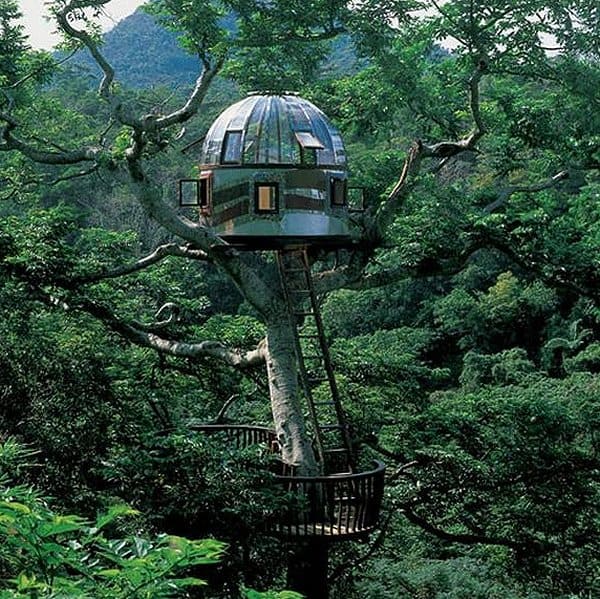
The Beach Rock Treehouse in Nakijin, northern Okinawa, is one of those rare structures that earns every superlative thrown at it. Architect Kobayashi Takashi designed it in 2005, pivoting from a career in fashion to building elevated hideaways in the forest canopy. The result stands among the tallest treehouses on the planet — and it looks like nothing else near it.
The exterior cladding is mirror-finish plexiglass, and that single material decision changes everything. At dawn the walls catch gold. By midday they turn a clean ocean-blue that mirrors the Okinawa sky. As afternoon fades, the surface shifts again — ember-orange, then a cooler silver when clouds move in. The building doesn't sit in the forest so much as record it, replaying the light back to anyone standing a few metres away.
Getting up there is a two-act experience. The first section is a staircase — manageable, with widening views of canopy and coastline as you rise. Halfway up, a timber platform offers a natural pause and the first proper look at the forest below. Then a ladder takes you the rest of the way. Gloves help. The climb earns the destination: by the top, the pace of an ordinary day has genuinely left you behind.
Inside, the atmosphere changes register entirely. Wood underfoot, leaf-shadows crossing the walls, the sound of wind working through branches just outside. Kobayashi designed the interior calm as a deliberate counterpoint to the spectacle of the outside. There is no agenda here. You sit, the light shifts five times in twenty minutes, and the effect is oddly compelling rather than passive.
Visiting between December and March brings Okinawa's most comfortable conditions — warm without the summer intensity, with lower humidity and clear skies that make the plexiglass reflections particularly sharp. Autumn, from October into November, is a quieter alternative: the sea stays warm, temperatures ease off, and the forest remains dense and green. Peak summer brings heat and the occasional typhoon, which suits adventurous visitors but demands flexibility.
Northern Okinawa is not well connected by rail, and most visitors reach Nakijin by car or organised transfer from Naha. Several bus stops, including those in the 謝名 (Shana) area, sit approximately 1.1 km from the resort — useful for those without a vehicle, though service to this part of the peninsula is limited. Unten Port ferry terminal lies roughly 3.6 km away, serving inter-island connections rather than mainland access.
The Beach Rock Treehouse suits travellers who want something genuinely singular — not a themed room with a view, but a designed experience built around light, height and natural quiet. Photographers, architects, and anyone who has ever wanted to watch a building change colour in real time will find it memorable. It rewards stillness, and it looks different every time you blink. That is entirely the point.
Frequently Asked Questions
Q: What makes the exterior of the Beach Rock Treehouse visually distinctive?
A: The entire exterior is clad in mirror-finish plexiglass, which reflects and shifts colour throughout the day — catching gold at dawn, a clear ocean-blue at midday, and ember-orange as afternoon fades. The effect means the building appears to change with the light rather than sit fixed against the forest.
Q: How physically demanding is the climb to reach the treehouse?
A: The ascent comes in two stages: a staircase leads to a timber platform roughly halfway up, where you get the first clear view of the canopy and coastline below, then a ladder takes you the rest of the way to the top. Gloves are recommended for the ladder section. The climb is manageable but hands-on — not suited to those who are uncomfortable with heights or ladders.
Q: When is a good time of year to visit?
A: December through March tends to be the most comfortable period — warm but not intense, with lower humidity and clearer skies that make the plexiglass reflections particularly sharp. Autumn (October to November) is a quieter alternative, with easing temperatures and a still-green forest. Summer brings heat and occasional typhoons, which suits flexible travellers but demands some planning around weather.
Q: How do visitors typically reach the Beach Rock Treehouse from Naha?
A: Northern Okinawa is not well served by rail, and a car or organised transfer from Naha is the most practical option for most visitors. Some bus routes serve the broader Nakijin area, with stops around 1.1 km from the resort, though services to this part of the peninsula are limited. Confirm current timetables before relying on public transport.







Add a review