

Treeful Treehouse Sustainable Resort sits in the Yanbaru forest of northern Okinawa, near Nago City, where the jungle runs dense and the canopy closes in overhead. Founded by Satoru Kikagawa and his daughter Maha, the resort opened in 2021 after years of deliberate design work. Their guiding principle is coexistence — the idea that a building can share a forest without diminishing it. Every treehouse here sits at least 1.2 metres off the ground, preserving root systems and letting filtered sunlight reach the forest floor below.
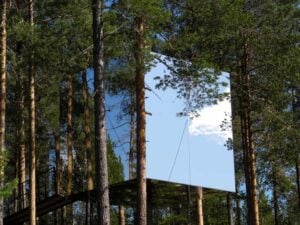
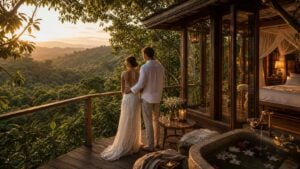
Five individually designed structures give each guest a genuinely different experience. The Spiral Treehouse is the most distinctive: its curved form wraps a central core, with a staircase climbing toward unobstructed forest views and floor-to-ceiling glazing that frames the canopy on every side. AeroHouse takes a more contemporary approach — a glass-floored structure suspended between trees, feeling simultaneously like a room and a viewing platform. Bamboo Tree House uses locally sourced bamboo and is designed to breathe with the forest rather than seal against it. Trophy Treehouse is quieter and more minimal. Halcyon adds practical ease with a microwave, refrigerator and other considered amenities that make longer stays comfortable.
The resort's sustainability credentials go well beyond marketing. Treeful operates as carbon negative, meaning it absorbs more CO₂ than it produces. Solar and eco-electric systems power the structures. Water comes from on-site wells and the nearby Genka River, purified through UV treatment rather than chlorine. Composting toilets and thoughtfully engineered sanitation systems handle waste quietly. A small herd of goats manages the grounds, replacing mechanical mowers. None of this compromises comfort — hot showers, reliable power and well-maintained interiors are standard across all five treehouses.
Daily life here takes its rhythm from the forest. Guests can trek along the Genka River, discover hidden waterfalls in the surrounding hills, or relax in a private sauna positioned beside a natural cascade. Fireside dinners beneath the canopy offer a slower alternative to an evening inside. The resort runs a Yanbaru Unbelievable View Tour, leading guests to secluded forest lookouts not accessible independently. After dark, cicadas set the soundtrack and, at the right time of year, fireflies move between the trees.
Nightly rates run approximately $800–$1,000, reflecting the property's luxury positioning, with rates varying by season and availability. Okinawa's winter and spring months — December through April — bring the most comfortable conditions, with cooler temperatures and lower humidity. Autumn, from October into November, offers warmth and calm without the intensity of the summer wet season.
Getting to Treeful requires planning. The resort's deep-forest location in northern Okinawa means a rental car or private transfer is the most practical option for most visitors. Nago bus terminal, approximately 11 km away in straight-line distance, is served by bus lines 20, 111 and 120, connecting to wider parts of the island — though bus timing from the terminal to the resort itself warrants checking in advance. Unten Port, around 12 km away, handles ferry connections to the outlying islands.
Treeful suits guests who are specifically seeking canopy solitude, genuine environmental credentials and an immersive encounter with the Yanbaru forest. It is not designed for those expecting a conventional resort with pools, large-scale facilities or easy urban access. What it offers instead — five architect-designed treehouses, a carbon-negative footprint, and a founders' philosophy visible in every structural choice — is increasingly rare at any price point.
Frequently Asked Questions
Q: What are the nightly rates at Treeful Treehouse Sustainable Resort?
A: Rates run approximately $800–$1,000 per night, reflecting the resort's luxury positioning. Prices vary by season and availability, so check the resort's official booking page for current figures.
Q: When is the best time to stay at Treeful?
A: December through April brings Okinawa's coolest and driest conditions, making it the most comfortable season for forest living. Autumn — October and November — is also a strong choice: warm and calm without summer's heat and humidity. June through September is hot and tropical, which suits beach-focused visitors but can feel intense in a forest treehouse setting.
Q: How do the five treehouses differ from one another?
A: Each structure has a distinct character. The Spiral Treehouse is the most iconic, with a curved form and floor-to-ceiling glazing framing the canopy. AeroHouse features a glass floor and feels more like a suspended viewing platform. Bamboo Tree House uses locally sourced bamboo and is designed to breathe with the forest. Trophy Treehouse takes a quieter, minimal approach. Halcyon is the most practically equipped, with a microwave and refrigerator suited to longer stays.
Q: Is Treeful genuinely sustainable or mainly a marketing claim?
A: The credentials go deeper than branding. The resort operates carbon negative, runs on solar and eco-electric power, sources water from on-site wells and the nearby Genka River purified by UV treatment, uses composting toilets, and keeps a small herd of goats to manage the grounds in place of mechanical mowers. All treehouses are elevated at least 1.2 metres off the ground to protect root systems beneath.
Q: Do guests need a car to reach the resort?
A: The resort sits deep in the Yanbaru forest near Nago City in northern Okinawa. A rental car or private transfer is the most practical option for most visitors. Nago bus terminal is approximately 11 km away and served by several bus lines, but the forest location makes driving the more straightforward approach.





Add a review